
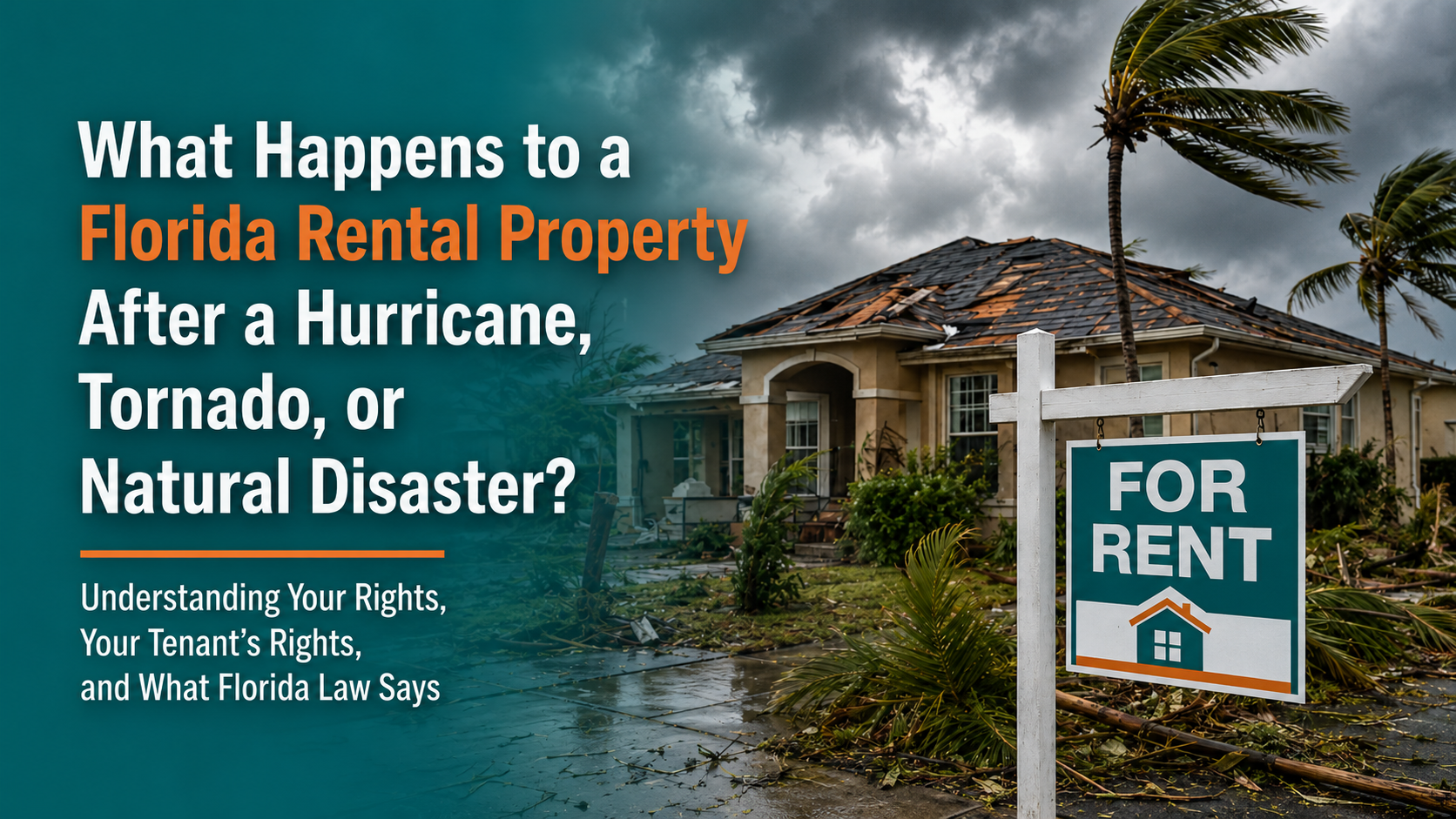
What Happens to a Florida Rental Property After a Hurricane, Tornado, or Natural Disaster?
Living and investing in Florida comes with plenty of advantages, but it also comes with risks. Hurricanes, tornadoes, flooding, severe thunderstorms, fires, and other disasters can cause anything from a blown-down fence to the complete destruction of a home.
The recent devastating 7.4-magnitude earthquake in Colombia was a sobering reminder of how quickly a natural disaster can change people’s lives and destroy homes and infrastructure. Reuters
It also raises an important question for Florida rental property owners:
What happens to your tenant and lease if a hurricane, tornado, fire, or other disaster damages your rental property?
The answer depends largely on the severity of the damage and whether the tenant can continue safely using the property.
At Elliott & Eijo Group, we believe rental property owners should understand these possibilities before an emergency happens.
Florida Law Addresses Casualty Damage to Rental Properties
Florida law specifically addresses this situation.
Under Florida Statute §83.63, “Casualty Damage,” when a rental property is damaged or destroyed through no wrongful or negligent act of the tenant and the damage substantially impairs the tenant’s enjoyment of the property, the tenant has certain rights. Depending on the circumstances, the tenant may terminate the rental agreement and immediately vacate, or the tenant may vacate only the unusable portion of the property and receive an appropriate reduction in rent. Florida Statute §83.63
In practical terms, we can think of disaster damage in three general categories.
Scenario 1: The Property Is Damaged but Still Habitable
This is probably the most common situation following a Florida storm.
Imagine a hurricane comes through Lakeland and damages a rental property’s fence. There may be missing shingles, damaged screens, broken tree limbs, or minor exterior damage, but the home remains structurally safe and the tenant still has electricity, plumbing, working bathrooms, secure doors and windows, and normal use of the home.
A damaged property is not automatically an uninhabitable property.
Florida landlords generally have an obligation to comply with applicable building, housing, and health codes and to maintain important structural components of the property, including roofs, windows, doors, floors, exterior walls, foundations, and plumbing. Certain obligations can differ for single-family homes and duplexes based on the written agreement. Florida Statute §83.51
For an owner, this means the response after a storm should be organized and documented.
We want to determine:
- Is the property safe to occupy?
- Is there active water intrusion?
- Is the roof secure?
- Are the electrical and plumbing systems functioning safely?
- Are exterior doors and windows secure?
- Is there structural damage?
- Are there fallen trees or other immediate hazards?
- Does the property need emergency mitigation to prevent additional damage?
If the home remains habitable, the tenancy will generally continue while necessary repairs are coordinated, subject to the lease and applicable law.
A blown-down fence, for example, ordinarily would not have the same consequences as a collapsed roof.
Scenario 2: Part of the Property Cannot Be Used
Now imagine a hurricane causes a tree to fall onto an attached garage or damages one bedroom.
The remainder of the house may still be safe, but the tenant has lost the use of a meaningful portion of the property.
This is where Florida’s casualty-damage statute becomes especially important.
Florida Statute §83.63 provides that when casualty damage substantially impairs the tenant’s enjoyment of the premises, the tenant may vacate the portion rendered unusable. In that situation, the tenant’s rent liability is reduced by the fair rental value of the portion of the property that was damaged or destroyed. Florida Statute §83.63
This isn’t necessarily as simple as saying, “One of four bedrooms is damaged, so rent automatically goes down 25%.”
The statute refers to the fair rental value of the unusable portion. The specific facts matter.
That’s why professional documentation and communication are extremely important after a casualty.
Scenario 3: The Property Is No Longer Habitable
This is the situation every property owner hopes never happens.
Imagine a major hurricane removes a significant portion of the roof. A tornado causes structural failure. A fire destroys much of the interior. Floodwater severely damages the home. Authorities determine the building is unsafe to occupy.
If the damage or destruction substantially impairs the tenant’s enjoyment of the premises and was not caused by the tenant’s wrongful or negligent actions, Florida Statute §83.63 allows the tenant to terminate the rental agreement and immediately vacate the property. Florida Statute §83.63
That is an important distinction for rental property owners.
A lease does not necessarily guarantee that rent will continue for the remainder of the lease when a casualty has made the property unusable.
If the tenancy is terminated under the casualty-damage statute, the landlord must also handle the tenant’s security deposit in accordance with Florida’s security-deposit law, §83.49(3). Generally, if no claim is being made, the deposit must be returned within 15 days after termination. If a claim is being made, Florida law establishes specific notice requirements and deadlines, including generally providing notice within 30 days after termination. Florida Statute §83.49
What About the Tenant’s Belongings?
A badly damaged home can create another complicated situation: the tenant may have personal property trapped inside.
Florida law addresses this as well.
Following casualty damage, the tenant must be given an opportunity to collect belongings when it is safe to do so, or receive notice of when the belongings can be collected within a reasonable time. Florida Statute §83.63
Safety comes first.
If firefighters, building officials, emergency management personnel, engineers, or other authorities have determined that a structure is unsafe, nobody should be sent inside simply to retrieve furniture, clothing, electronics, or other belongings until safe access is permitted.
Who Pays for the Tenant’s Hotel or Temporary Housing?
This is one of the first questions owners and tenants tend to ask after a disaster.
There is an important difference between the landlord’s responsibility for the rental property and insurance coverage for the tenant’s personal belongings and temporary living expenses.
A landlord’s property insurance is primarily intended to protect the owner’s insured property interests, subject to the particular policy and its exclusions. A tenant should not assume the landlord’s policy will pay for the tenant’s damaged furniture, electronics, clothing, hotel, or other personal expenses.
Those are important reasons for tenants to maintain appropriate renters insurance and understand what their individual policy covers.
Owners should similarly review their landlord insurance policies to determine whether they have appropriate coverage for the building, liability, hurricane/wind damage, loss of rental income, and other relevant risks.
Never assume something is covered simply because you have insurance. Policies, deductibles, exclusions, flood coverage, wind coverage, and loss-of-rent provisions can vary significantly.
Flooding Deserves Special Attention in Florida
Flood damage is especially important because insurance coverage can work differently from wind or other storm-related losses.
Florida also now requires landlords to provide a separate flood disclosure to prospective residential tenants at or before signing rental agreements with terms of one year or longer. The statutory disclosure specifically warns tenants that renters insurance policies do not include flood-damage coverage and encourages tenants to discuss separate flood insurance with their insurance agent. Florida Statute §83.512
For Florida property owners, flood risk shouldn’t be considered only when a property is located directly on the coast. Heavy rainfall, overwhelmed drainage systems, lakes, rivers, and tropical systems can create flooding well inland.
What Should Happen Immediately After a Hurricane or Natural Disaster?
When a major storm affects one of our managed properties, the first priority isn’t cosmetic repairs. It is determining the condition and safety of the property.
A proper response may include documenting the property with photographs and video, identifying emergency conditions, communicating with the tenant and owner, arranging emergency mitigation, contacting appropriate contractors, determining whether the home remains safe to occupy, and helping the owner document information needed for an insurance claim.
Owners should also notify their insurance carrier promptly when appropriate and follow the carrier’s instructions regarding documentation and mitigation.
One of the biggest mistakes after a storm is allowing relatively manageable damage to become much worse.
A small roof opening can become major interior water damage. Standing water can lead to additional problems. A broken window can expose the interior to rain. A fallen tree can create additional structural or safety issues.
Stopping additional damage can be just as important as repairing the original damage.
What If the Tenant Caused the Damage?
Natural-disaster casualty rules shouldn’t be confused with tenant-caused damage.
Florida Statute §83.63 specifically addresses premises damaged or destroyed other than by the wrongful or negligent acts of the tenant. Florida Statute §83.63
If a tenant’s negligence caused or contributed to a loss, the situation can be different.
For example, damage from a hurricane is very different from damage caused by a tenant negligently starting a fire. Responsibility can depend on the facts, the lease, insurance coverage, and Florida law.
That is another reason we document significant property damage carefully before determining financial responsibility.
Insurance Is Part of Your Investment Strategy
Property owners often shop insurance based primarily on premium. Price matters, but so does understanding what you’re actually buying.
Ask your insurance professional questions such as:
Does my policy cover wind damage? What is my hurricane deductible? Do I have flood coverage? Do I have loss-of-rental-income coverage? How long does that coverage last? Are there exclusions for water damage? What happens if the property cannot legally be occupied?
Saving money on an insurance premium isn’t much of a savings if you discover after a disaster that the loss you expected to be covered was excluded.
For rental property owners, loss-of-rent or rental-income coverage can be particularly important. If a covered casualty makes a property uninhabitable and the tenant is legally able to terminate the lease, the owner may lose rental income while still having a mortgage, taxes, insurance, HOA fees, and other expenses.
The exact protection depends on the owner’s individual insurance policy, so owners should review this coverage with a qualified insurance professional.
Why Professional Property Management Matters During a Disaster
Most of the time, property management is predictable. We collect rent, coordinate maintenance, communicate with tenants, perform inspections, renew leases, and market vacant properties.
It’s during the unexpected events that having systems in place becomes especially valuable.
After a hurricane or other natural disaster, an owner may suddenly be dealing with a frightened tenant, damaged property, contractors, insurance adjusters, photographs, estimates, emergency mitigation, rent questions, lease questions, security deposits, and dozens of decisions at the same time.
Our job as property managers is to help bring organization to that situation.
We document what happened. We communicate with the tenant. We coordinate necessary repairs and inspections. We keep the property owner informed. And when landlord-tenant law comes into play, we make sure the situation is handled according to the lease and applicable Florida law, consulting appropriate legal professionals when necessary.
From a Fallen Fence to a Destroyed Home, Every Situation Is Different
A natural disaster could blow over one section of fence and have almost no impact on a tenancy.
That same storm could make another home partially unusable.
A few streets away, it could make a property completely uninhabitable.
That’s why there isn’t a single answer to the question, “What happens to my rental property after a hurricane?”
The severity of the damage matters.
Whether the property remains safe and usable matters.
The lease matters.
Insurance coverage matters.
And Florida landlord-tenant law matters.
For Florida rental property owners, the best time to understand these issues is before the storm is on the radar.
Protect Your Florida Rental Property With Experienced Property Management
At Elliott & Eijo Group, we help rental property owners throughout Lakeland, Polk County, and Central Florida protect their investments through professional property management, proactive communication, documentation, tenant screening, inspections, maintenance coordination, and experienced guidance.
If you own a rental property and have questions about how your property would be handled before or after a hurricane, tornado, or other natural disaster, contact Elliott & Eijo Group to learn more about our property management services.
This article is provided for general informational purposes and should not be considered legal, insurance, or tax advice. Florida laws and individual circumstances can change. Property owners should consult a qualified Florida attorney and insurance professional regarding their specific property, lease, and insurance coverage.