
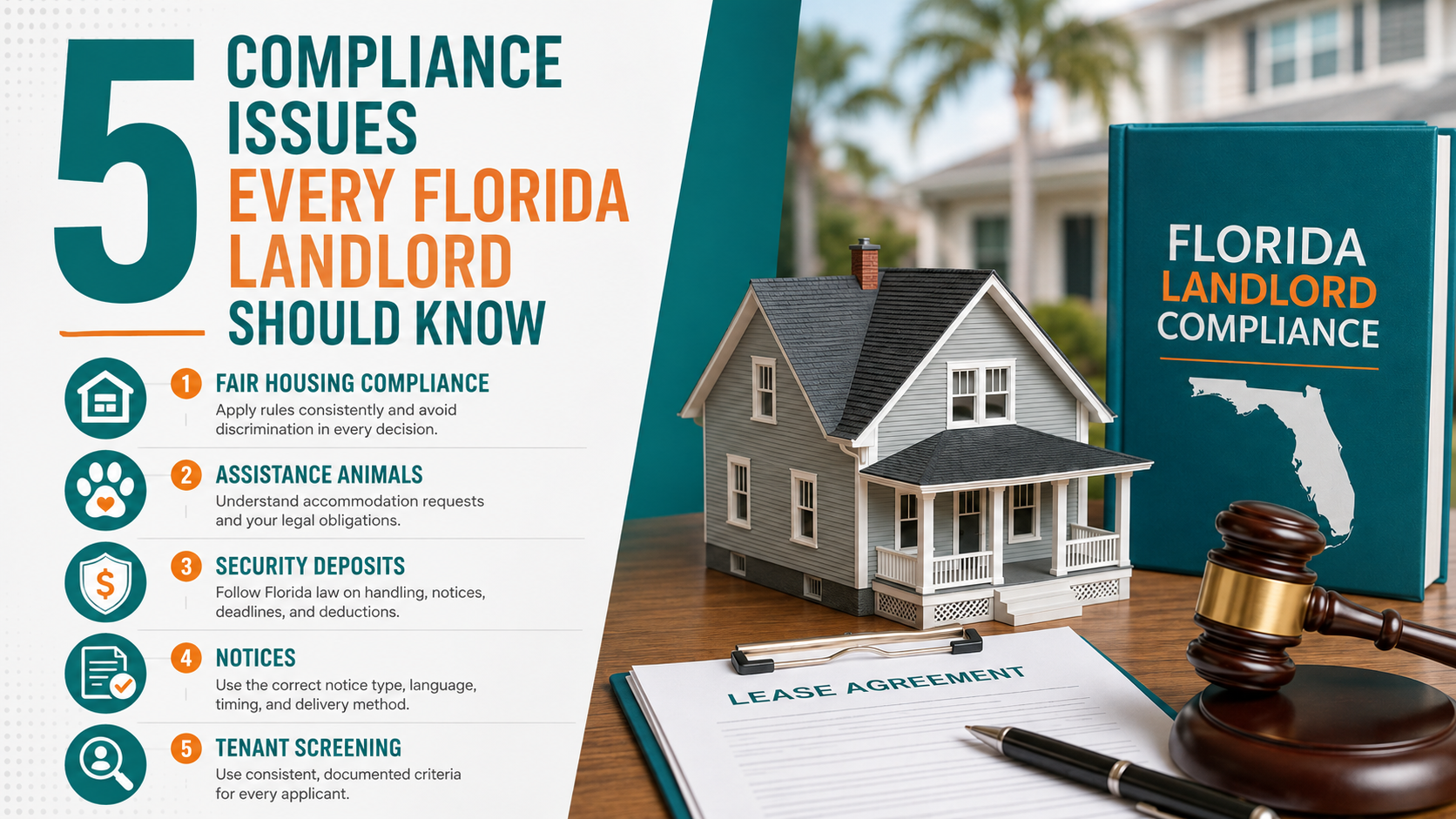
5 Compliance Issues Every Florida Landlord Should Know
Owning a rental property seems pretty straightforward on the surface.
Find a qualified tenant. Collect the rent. Maintain the property. Enforce the lease.
But some of the biggest risks in rental property ownership aren't nearly as obvious.
A landlord can have a great property, a responsible tenant, and a professionally written lease—and still run into problems because a notice was delivered incorrectly, a security deposit deadline was missed, a rental advertisement used the wrong language, or an assistance animal request wasn't handled properly.
And unfortunately, “I didn't know” usually isn't much protection when a landlord-tenant issue becomes a legal or regulatory problem.
Here are five compliance areas every Florida rental property owner should understand.
1. Fair Housing Rules Affect More Than Who You Approve
Most landlords understand that they cannot discriminate against prospective tenants.
But Fair Housing compliance goes much further than simply approving or denying an application.
The federal Fair Housing Act protects individuals from housing discrimination based on race, color, national origin, religion, sex, familial status, and disability. Florida law provides additional protections and requirements that housing providers must also consider.
Fair Housing considerations can affect nearly every stage of the rental process, including:
- Rental advertisements
- Applicant conversations
- Showing procedures
- Screening criteria
- Approval and denial decisions
- Lease terms
- Rules and policies
- Reasonable accommodation requests
- Tenant communications
- Enforcement of lease violations
Even language that seems harmless can potentially create a problem.
For example, an advertisement describing a property as “perfect for a young professional” may sound like ordinary marketing language, but it can raise Fair Housing concerns because it suggests a preference for a particular type of occupant.
The safer approach is to market the property, not the type of person you imagine living there.
Describe the bedrooms, yard, kitchen, neighborhood amenities, location, upgrades, and features of the home.
Let prospective tenants decide whether the property is right for them.
Consistency is also extremely important.
If you make exceptions to screening criteria, policies, fees, or lease requirements for one applicant but not another, you should understand why and have appropriate documentation supporting that decision.
Good intentions don't replace consistent procedures.
2. Assistance Animals Are Not the Same as Pets
This is one of the most misunderstood areas of rental property management.
A landlord may have a perfectly legitimate no-pet policy and still be required to consider a tenant's request for an assistance animal as a reasonable accommodation.
Under Fair Housing laws, an assistance animal can be treated differently from an ordinary household pet. Florida also has specific laws addressing emotional support animals and housing.
That distinction matters.
A landlord generally should not simply respond:
“We don't allow pets.”
Nor should an owner automatically charge the same pet deposit, pet rent, or pet fees that would normally apply to an ordinary pet if the animal qualifies as an assistance animal.
At the same time, landlords are not necessarily required to accept every piece of documentation presented to them without question.
There are procedures for evaluating accommodation requests, determining when supporting information may be requested, and addressing questionable documentation.
This is an area where having an established process is especially important.
The person answering the phone, replying to an email, or processing an application shouldn't be improvising the company's assistance-animal policy in real time.
3. Security Deposits Have Rules and Deadlines
A security deposit isn't simply money a landlord holds until the tenant moves out.
Florida law establishes specific requirements for how security deposits and advance rent are handled, including notice requirements and procedures at the end of a tenancy.
One of the areas landlords most commonly underestimate is what happens after the tenant moves out.
If a landlord does not intend to make a claim against the security deposit, Florida law generally requires the deposit to be returned within the applicable statutory timeframe.
If the landlord intends to make a claim, specific notice requirements and deadlines apply.
Missing those deadlines can substantially affect the landlord's ability to make a claim.
And the issue isn't only timing.
Documentation matters too.
If you're charging a former tenant for damage, you should be prepared to support that charge with things such as:
- Move-in condition documentation
- Move-out inspection documentation
- Photographs
- Vendor invoices
- Estimates
- Lease provisions
- Maintenance records
- Communication with the tenant
There is also an important distinction between tenant-caused damage and ordinary wear and tear.
A carpet that has gradually worn from normal use is very different from one that has been burned, permanently stained, or damaged by a tenant.
A landlord shouldn't wait until move-out to begin thinking about security deposit documentation.
The process really begins on the day the tenant receives possession of the property.
4. Notices Must Be Done Correctly
Landlords sometimes assume that because a tenant clearly violated the lease, the next step is simple.
Unfortunately, having a valid reason for taking action doesn't necessarily mean the landlord followed the correct procedure.
Florida's Residential Landlord and Tenant Act establishes specific notice requirements depending on the situation. These can include issues involving nonpayment of rent, lease violations, termination of certain tenancies, and other circumstances.
The type of notice matters.
The language matters.
The timing matters.
The method of delivery can matter.
And counting the applicable days incorrectly can create problems.
For example, the procedure for addressing unpaid rent is not necessarily the same procedure used for a lease violation.
Likewise, terminating a month-to-month tenancy involves different requirements than terminating a fixed-term lease.
This is one of those areas where downloading a random notice template from the internet can become surprisingly expensive.
A notice that looks professional isn't necessarily a legally appropriate notice for your situation.
When the next step could eventually involve an eviction or other legal action, getting the procedure right from the beginning becomes extremely important.
5. Tenant Screening Must Be Consistent and Documented
Most landlords know they should screen tenants.
The bigger question is:
How are you screening them?
A professional screening process should have established criteria that can be consistently applied to applicants.
That may include standards relating to:
- Income
- Rental history
- Credit
- Eviction history
- Criminal history
- Identification
- Employment or income verification
- Occupancy standards
- Application documentation
The danger comes when the criteria start changing depending on the applicant.
Imagine one applicant is required to earn three times the monthly rent, but another applicant is approved at 2.5 times the rent because the owner “liked them.”
Or one applicant's rental history is thoroughly verified while another person's isn't because they seemed trustworthy.
Those inconsistent decisions can create unnecessary Fair Housing exposure.
Housing screening policies should be applied consistently and in a nondiscriminatory manner.
Documentation is equally important.
If an applicant is denied because they failed to meet a legitimate rental criterion, your records should make it clear what criterion wasn't satisfied.
The decision shouldn't depend on someone's memory six months later.
And Those Aren't the Only Compliance Issues
These five areas are only part of the picture.
Florida landlords may also need to manage requirements involving:
- Property condition and habitability
- Repair obligations
- Lease disclosures
- HOA and condominium requirements
- Rent collection procedures
- Entry into the property
- Lease renewals
- Non-renewals
- Abandoned property
- Tenant privacy
- Maintenance records
- Insurance requirements
- Local ordinances
- Required disclosures
- Changing state and federal laws
And some requirements change over time.
That's one of the challenges of self-managing rental property.
You aren't just managing a house.
You're operating a housing business.
“But I've Been Doing It This Way for Years”
We hear variations of this frequently.
Maybe you've rented a property for ten years and never had a serious problem.
That's great.
But rental-property risk often works a little like insurance.
The fact that something hasn't happened yet doesn't mean the exposure isn't there.
One difficult tenant, Fair Housing complaint, improperly handled security deposit, missed notice deadline, poorly documented repair, or inconsistent screening decision can suddenly make a landlord wish the systems had been in place beforehand.
Good property management isn't only about solving problems.
It's about building procedures that make certain problems less likely to happen in the first place.
Systems Matter More Than Memory
One of the biggest differences between casually managing a rental property and professionally managing one is process.
Important responsibilities shouldn't depend on someone remembering what needs to happen.
There should be systems.
Applications should follow established screening criteria.
Assistance animal requests should follow an established review process.
Move-ins should include documented property-condition records.
Maintenance requests should be recorded and tracked.
Lease violations should follow established documentation and notice procedures.
Renewals should be addressed early enough to make informed decisions.
Move-outs should trigger an established inspection and security-deposit process.
The more standardized those processes become, the less likely important steps are to be missed.
This Is Where Professional Property Management Adds Value
A property manager's job isn't simply to collect rent and call a plumber when something breaks.
Professional property management involves hundreds of small operational decisions throughout a tenancy.
At Elliott & Eijo Group, our team has established systems for areas including:
- Marketing and advertising
- Applicant screening
- Lease preparation and administration
- Tenant communication
- Assistance animal processing
- Maintenance coordination
- Property inspections
- Lease compliance
- Documentation
- Renewal management
- Move-out inspections
- Security deposit processing
No system can eliminate every risk associated with owning rental property.
But having established procedures, trained team members, documentation, and professional oversight can significantly reduce the number of important decisions being made on the fly.
For a self-managing owner, keeping up with all of those responsibilities can quickly become a job in itself.
And that's really one of the biggest benefits of professional property management:
You don't have to become an expert in every part of the rental business simply because you own a rental property.
Protecting Your Investment Means More Than Collecting Rent
Rental property can be an excellent long-term investment.
But protecting that investment requires more than finding a tenant and making sure the rent arrives each month.
It requires good documentation, consistent procedures, proper maintenance, appropriate insurance, knowledge of landlord-tenant requirements, and a system for handling the dozens of situations that can arise throughout a tenancy.
At Elliott & Eijo Group, that's what our management systems are designed to provide.
If you're currently managing your rental property yourself and wondering whether professional management could make ownership easier, we'd be happy to talk.
Elliott & Eijo Group at S&D Real Estate Services, LLC
(863) 333-5161
This article is provided for general educational and informational purposes only and is not legal advice. Federal, state, and local housing laws and regulations can change and individual circumstances vary. Rental property owners should consult a qualified Florida attorney regarding specific legal or compliance questions.