
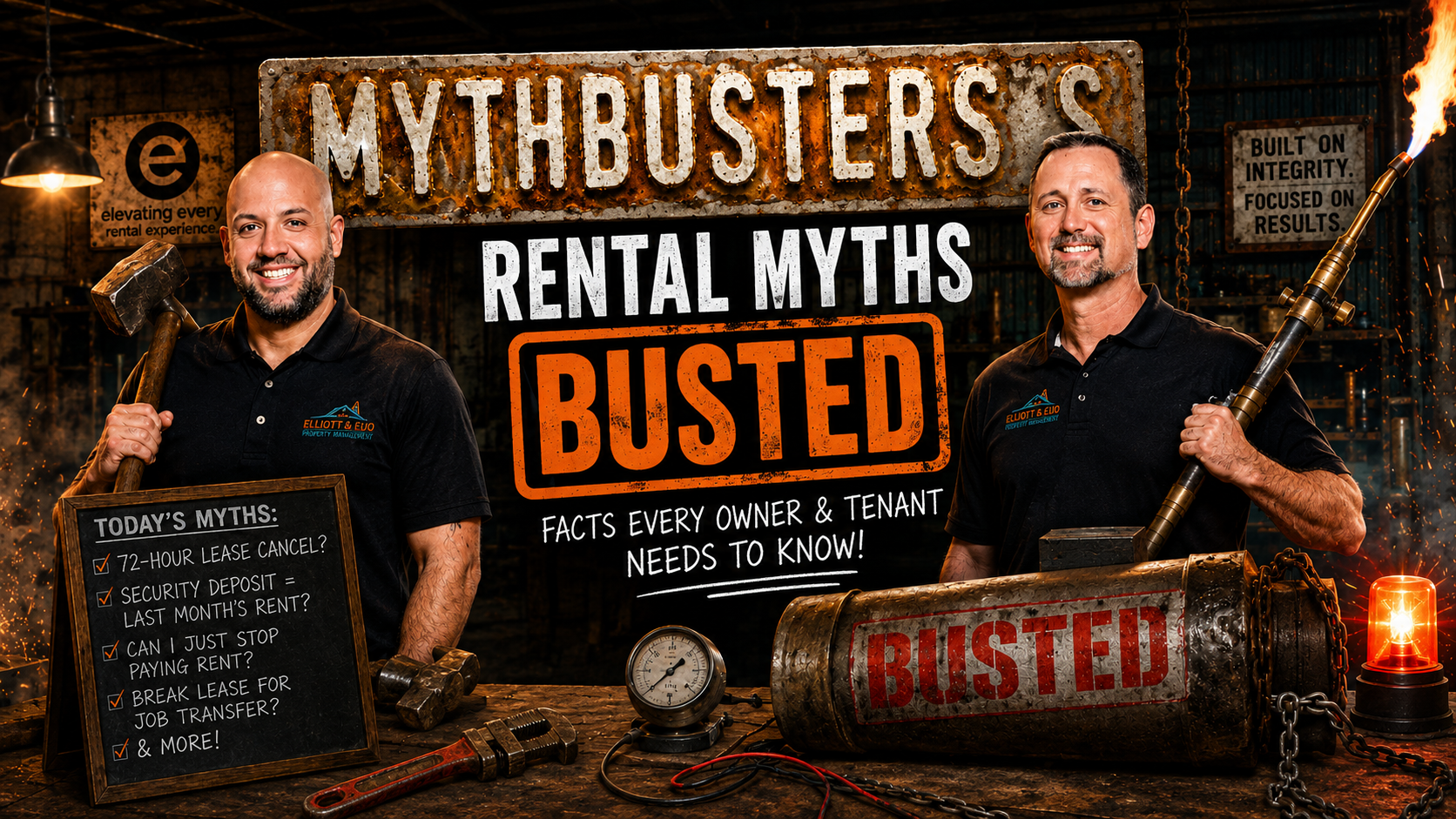
The Truth About Rental Myths: What Every Florida Owner and Tenant Needs to Know
Don't Let Bad Advice Cost You Time, Money, or Your Lease
If you've been around rental housing long enough, you've probably heard someone confidently say, "You have 72 hours to cancel a lease," or "You can just use your security deposit as your last month's rent."
The problem?
Most of these statements simply aren't true.
At Elliott & Eijo Property Management, we spend a surprising amount of time helping owners and tenants separate fact from fiction. Unfortunately, bad information spreads quickly — through social media, friends, family, or advice that may be accurate in another state but has nothing to do with Florida law.
Let's clear up some of the biggest rental myths we hear every day.
Myth #1: "I Have 72 Hours to Cancel My Lease."
This is one of the most common misconceptions we encounter.
Many contracts — such as certain door-to-door sales — include a rescission or "cooling off" period. Because of that, many people assume residential leases work the same way.
They don't.
Once all parties have signed the lease and it has been fully executed, it becomes a legally binding contract. Florida law does not provide a general 72-hour period allowing a tenant to simply change their mind.
If you've signed the lease, committed to moving in, and then decide you've found another place two days later, the lease doesn't automatically disappear.
That's why we always encourage tenants to ask questions before signing — not after.
Rental Myths That Just Won't Go Away
Myth: "I'll just use my security deposit for my last month's rent."
Your security deposit is exactly what its name says — a security deposit.
It protects the property owner against unpaid rent, damages beyond normal wear and tear, cleaning costs, and other allowable deductions under Florida law.
Unless your lease specifically says otherwise, it is not intended to replace your final rent payment.
Myth: "My friend is just visiting with their dog."
Many leases prohibit unauthorized animals — not just permanent pets.
If an animal is repeatedly staying at the property, it may still violate the lease regardless of who technically owns it.
Always communicate with your property manager before bringing animals into the property.
Myth: "I can break my lease because I got transferred for work."
A job transfer may be stressful, but it generally does not automatically cancel your lease.
Some employers may assist with relocation costs, but unless your lease contains specific language allowing termination, the lease remains enforceable.
The good news? Professional property managers often work with tenants to minimize costs and help create a smooth transition whenever possible.
Myth: "If the owner sells the property, my lease ends."
This one surprises many people.
In most cases, the lease stays with the property.
When ownership changes, the new owner generally assumes the existing lease and its obligations until it expires.
Buying a rental property usually means buying the lease too.
Myth: "I can withhold rent until something gets fixed."
Florida law has very specific procedures regarding maintenance issues.
Simply deciding not to pay rent can place a tenant in default — even if legitimate maintenance concerns exist.
Communication is always the best first step. If repairs are needed, notify your property manager promptly and document the issue.
Myth: "I can repair something myself and deduct it from my rent."
This is another misunderstanding that comes from laws in other states.
Florida does not generally allow tenants to make repairs on their own and simply subtract the cost from the rent.
Making unauthorized repairs could actually create additional problems for both the tenant and the property owner.
Myth: "An eviction always takes six months."
Not necessarily.
Every eviction is different.
The timeline depends on factors such as:
- Whether the tenant responds
- Court schedules
- The reason for the eviction
- Whether the tenant contests the case
Some cases move much faster than many people expect, while others can take longer.
Myth: "Children prevent an eviction."
Having children does not prevent an eviction.
The legal process applies equally to all tenants regardless of family size.
Myth: "The landlord has to repaint or replace carpet every few years."
Florida law does not require landlords to repaint or replace flooring on a fixed schedule.
Instead, owners are responsible for maintaining safe and habitable housing. Normal wear and tear is expected, but replacement decisions depend on the property's actual condition — not an arbitrary timeline.
Myth: "An ESA or service animal has to be registered."
This is one of the biggest misconceptions surrounding assistance animals.
Legitimate service animals and Emotional Support Animals, also known as ESAs, are not defined by an online registration or certificate. Many websites sell official-looking documents that have little or no legal significance.
Accommodation requests are handled under applicable fair housing laws — not by purchasing an ID card online.
Why This Matters to Property Owners
Bad information doesn't just affect tenants — it can cost owners money as well.
When expectations are based on myths instead of facts, it often leads to:
- Delayed move-ins
- Lease disputes
- Missed rent payments
- Unnecessary legal expenses
- Frustration on both sides
Working with an experienced property management company helps prevent these misunderstandings before they become expensive problems.
At Elliott & Eijo, we believe education is one of the best tools available to protect both owners and tenants. Our goal is to communicate clearly, follow Florida law, and help everyone understand their rights and responsibilities from day one.
The Bottom Line
The internet is full of rental advice — but not all of it applies to Florida.
Before making an important decision based on something you heard from a friend, read on social media, or found in an online forum, verify the information with a qualified property management professional or attorney familiar with Florida landlord-tenant law.
A quick conversation today can prevent a costly mistake tomorrow.
Need Professional Property Management in Central Florida?
Whether you're a property owner looking for experienced management or a tenant with questions about your lease, the Elliott & Eijo Group at S&D Real Estate Services is here to help.
With more than 20 years of experience, hundreds of properties under management, and a reputation built on communication and professionalism, we're committed to making the rental experience better for everyone involved.
Have questions about Florida rental laws or property management? Contact Elliott & Eijo today — we're happy to help.